Showing posts with label 1960s. Show all posts

Tuesday, February 22, 2022

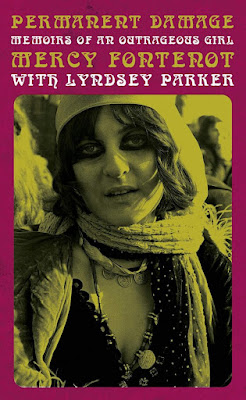
Book Review: Permanent Damage: Memoirs of an Outrageous Girl by Mercy Fontenot with Lyndsey Parker


Mercy  Fontenat, otherwise known as Miss Mercy of the GTOS, led an iterant rock ‘n’ roll life life. A butterfly of a music fan, Mercy’s travels took her from Haight Asbury to Laurel Canyon to Stax in Memphis to the punk rock scene in Hollywood. She befriended and worked with many rock icons and had trysts with others. That’s the good news. The bad news? She got caught up with drugs at a young age. Mercy (born Judith Peters) had a dysfunctional childhood. Her Dad was a gambler with a predilection for showgirls, and her family traveled across the country. Mercy ran away from cushy San Mateo, California to SF’s Haight Ashbury as a teenager, and soon took on the moniker Mercy, after the Don Covay song.

 Although Mercy spent her whole life around the music scene, she’s primarily remembered as a member of the GTOs, an avant-garde singing and performance art troupe.

The GTOs (Girls Together Outrageously) were a psychedelic combination of female Hollywood scenesters/groupies. They first got together as the Laurel Canyon Ballet Company and released one Frank Zappa produced album, Permanent Damage, in 1969. The group consisted of Miss Pamela (Pamela Des Barres)  Miss Sparky (Linda Sue Parker), Miss Lucy (Lucy McLaren), Miss Christine (Christine Frika),  Miss Sandra (Sandra Leano), Miss Cynderella (Cynthia Wells Cale-Binion) and Miss Mercy (Mercy Fontenat).  Fontenat, arguably the quirkiest member of the GTOs, passed away in July 2020 after a long illness. This leaves Pamela and Sparky as the last living members of the group.
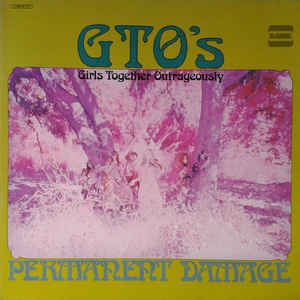


Zappa recruited Fontenot to join the GTOs at the last minute, intrigued by her wild gypsy look. Pamela Des Barres remembers Mercy as a “threat to normalcy”. Mercy’s autobiography, Permanent Damage: Memoirs of an Outrageous Girl, was released posthumously in June 2020.  Yahoo music editor Lyndsey Parker interviewed Fontenot extensively for several years to unravel the tale of an unorthodox, colorful, (and sometimes dangerous) life.

Permanent Damage combines Mercy's overarching love of music, fashion, pop culture trends through the decades, unorthodox relationships with musicians, and sometimes unsettling side jaunts involving drugs and unsavory characters. Mercy has a sense of humor and no self-editing, which actually is good because you always knew she was telling the truth. She had no agenda.

Of the GTOs, Mercy says: “The ethos of punk was that you didn’t have to be a professional musician or be trained to play and read music…. You could do it yourself. The GTOs were like that. I guess we were punk rock in our own way.”

The GTOs played an infamous show at L.A.’s Shrine Auditorium as the opening act on a bill with Frank Zappa and Alice Cooper. Their combination of comedy, theater, and singing was utterly unique and very much of its time.  Mercy remembers that she and Pamela got really stoned on pot while riding with Gram Parsons in his T-Bird before the show. Miss Christine admonished Mercy before the show, fearing the worst, but the show was a hit. Unfortunately, only a few photos of their performance exist, and there’s a short clip of the performance in Alex Winter’s Zappa documentary. 
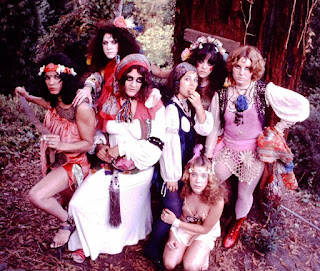


The GTOs socialized with a lot of the movers and shakers of the music, underground and hippie movement. I never thought about it before, but could it be the “Miss” before the GTOs’ names were cadged from friend and fan Tiny Tim’s habit of addressing females with “Miss” before their first name.

Jeff Beck, Rod Stewart, The Monkees’ Davy Jones and Nicky Hopkins provided musical backdrop for the GTOs album; Lowell George produced it. Rod Stewart, then a rock star-in-training, sang on Mercy’s song The Ghost Chained to the Past, Present, and Future (Shock Treatment) She also took Rod thrift store shopping and helped him develop his early look with The Faces. Decades later, when she was a homeless crack addict in Hollywood, she saw Stewart walk into the Pantages Theater before one of his concerts. She called to him, and he waved at her and moved on. Did she feel bad about it? “Shame isn’t a thing I do”, she says, “After all, I looked cute.”

Mercy doesn’t pull any punches about her fellow groupies, other scenesters, and her various sexual encounters. The ickiest moment involved Chuck Berry, a bucket, and bathroom function. Mercy said she later felt bad about it, but at least there were no pictures. Although she confessed to not liking sex that much, she had relationships with several musicians, including Arthur Lee of Love and Jobriath.  She actively pursued the funk musician Shuggie Otis and eventually married him. The couple had a son, Lucky, also a musician. 

The list of musicians in her orbit reads like a who’s who of rock –the Stones, Jimi Hendrix, Rod Stewart, Gram Parsons, Al Green, Otis Redding, etc.

Here are just a few examples of Mercy’s rock ‘n’ roll adventures:

  • She read the Stones’ tarot cards before Altamont
  • Popped out of a cake at Alice Cooper’s birthday party at the Ambassador East while on LSD. She also helped Alice devise his initial look.
  • Dropped out of beauty school but became a hairdresser anyway, hung out with the Gears and other punk rock bands in Hollywood, went to the famous punk club the Masque
  •  A pre-fame Courtney Love meet Mercy on a Hollywood bus and gave Mercy her phone number 
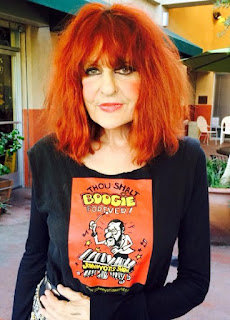

Many of Mercy’s cast of rock ‘roll characters disappeared from the scene, or died from drug abuse or violence.  She kept in contact with her parents and her sister throughout the years, but her family of origin didn’t provide much comfort. Music and her friends kept her positive. Finally off drugs for good, she turned her life around. Her son Lucky and job at Goodwill Industries kept her grounded.

For all her bravado, there are a few times Mercy expresses remorse about how her drug use affected others, and about glitches in her relationships with ex-husband Shuggie Otis and their son Lucky. 

Near the end of her life, Mercy once again appeared in the public eye.  She appeared in photos for the Starcrawler song “She Gets Around”, co-starred in an internet fashion promo, and often appeared at many readings with her BFF Miss Pamela.

Fontenot's story reveals the seedy underbelly to the peace and flower power generation. There’s as much drugs and violence here as rock ‘n’ roll, much of it pretty intense. There is a dizzying array of arrests, rapes, physical and emotional abuse, bad decisions, and all the other dangers lurking to people way out on the fringes. No wonder Parker asked Fontenot several times during interviews for book, “How are you even alive?” Mercy persevered and slayed most of her demons. Despite her hardships, Mercy’s wisecracking persona and love of music remained intact. She is regarded, along with rest of the GTOs, as a rock trailblazer for her outrageousness and style. Marianne Faithful, John and Exene of X, Shirley Manson, Alice Cooper, Dave Davies and other rockers laud Mercy for her contributions to rock music culture.

Permanent Damage: Memoirs of an Outrageous Girl revisits a wild roller coaster of a life with honesty and humor. 


                                            The GTOs (From Straight to  Bizarre documentary)


Tuesday, November 30, 2021

Some Initial Comments on "Get Back": Peter Jackson's Documentary About the Beatles' 1969 Recording Sessions


Beatles fans flooded Facebook and other social media sites with reviews of Get Back , director Peter Jackson's eight-hour documentary about the Fabs' 1969 recording sessions and rooftop concert, over Thanksgiving weekend. Lots of people who would otherwise never dream of sitting through eight hours of any film on Disney + subscribed to watch Get Back. (Unless you have a grandkid or two, Ice Age, endless Muppet and Star Wars movies, or Wreck-It Ralph, are probably not on your to-watch list.)   

Musicians and other creative people will find most the recording, jamming, and songwriting sessions fascinating. Causal fans and “normal” people. not so much.  

*SPOILERS*

Viewer advisory: Tobacco use (and copious quantities of tea and toast)

Part 1 plods along, but stick with it, things get more interesting when the band moves to Apple studios and Billy Preston joins them.

If you’re a causal fan or easily bored, you may want to stick to Part 3 only. If you get *really* bored easily, the rooftop concert starts an hour before the end of part 3.

Ringo offers comic relief with his fart comment. No one in the studio seems to pay much attention to it, however.

Heather wasn’t taking any of John’s BS (“You don’t eat any cats! They don’t taste good!” ) and it was cute when she imitated Yoko’s caterwauling.

Linda looked really pretty.

Yoko didn't cause any trouble, contrary to the myth. She just sat there (mostly silent) next to John, except for her trademark "singing" during an informal jam.

Ringo wore groovy shirts. I liked George’s Ugg-type boots in Part 3.

Who would have guessed that “Get Back” started out as a protest song about the anti-immigrant movement in the UK.

The police investigating the rooftop concert had a Keystone Cop vibe about 'em - but they were very polite.

John and Yoko had just finished filming Rock and Roll Circus with the Stones, thus John's running gag of, "And now your hosts for this evening, the Rolling Stones." 

Also, John didn’t seem to wash his hair much during this time. Ringo looked like he skipped the shampoo a few times, too

Some people have complained that they didn't like the interviews with pedestrians gazing up at the rooftop, but I enjoyed this exchange:

On-the-street interviewer- “You wouldn’t mind your daughter going out with a Beatle?”
On-the-street geezer - “I wouldn’t mind because they have money.”

John stops playing when Mal tells him about cops on the roof. When Paul sees the cops, he gives an enthusiastic  “Wooo!”

Some musical highlights: 

George helping Ringo work on the chords for "Octopus’s Garden".

Paul playing the melody for what would become "Let it Be" while everyone else mills about.

And Yay!!! A music documentary without Dave Grohl or Bono putting in their 1 1/2 cents! 


Saturday, May 23, 2020

Book Review: Set The Night On Fire: L.A. in the Sixties by Mike Davis and Jon Wiener


Set The Night on Fire:
L.A. In the Sixties
By Mike Davis and Jon Weiner

It’s been 50 years since the Kent State shootings. On May 4, 1970, four students –
Allison Krause, Jeffrey Glen Miller, Sandra Lee Scheuer, and William Knox Schroeder were shot and killed by National Guard Soldiers. The incident was just one of the high profile events that symbolized the social unrest of the 1960s and early 1970s. 

A few key images come to mind when you think about the  antiwar and civil rights era. Martin Luther King’s I Have a Dream speech, the marches in Selma, the 1968 Democratic Convention in Chicago, the Black Panthers, the assassinations of President Kennedy, RFK, and Martin Luther King.

But every city and college town had its own political and social movements. Some of these groups were truly underground, while others appeared in local newspaper articles and made their presence known to the police and the “establishment.”

 Set the Night on Fire, an ambitious study from Verso Books covers the left-wing socio-political movement in Los Angeles in the 1960s and early 1970s.

The book was written by two respected journalists long affiliated with the counterculture.  Mike Davis was a member of the Communist Party in California in the 1960s and a local organizer for the Students for a Democratic Society. His previous books include City of Quartz. Jon Weiner hosts the Start Making Sense podcast   He wrote Gimme Some Truth about the FBI files on John Lennon.

The book’s title comes from the Doors “Light My Fire” and the introduction features a brief statement from John Densmore of the Doors about life in the ‘60s L.A.

Set the Night on Fire gives us a well-rounded look at the growing fight for the rights of women, gays, African-Americans, and Mexican-Americans in the 60s’ L.A. as well as the anti-war movement. Many of the events and organizations mentioned in the book have been lost to history and relegated to newspaper archives.

The Stonewall riots in New York’s West Village is the most famous example of  demonstrations at a gay bar in the 1960s, and it brought gay rights into the mainstream media. The New Year’s Eve raid at Black Cat Tavern in Silverlake in 1967, and the subsequent uprising predated Stonewall by two years but is rarely mentioned today.


Many people have affixed the colorful LOVE stamp on letters at one time or another. This design, created by Sister Corita Kent of the Immaculate Heart of Mary in Los Angeles,  was one of the counterculture silkscreens. The Sister used her art partially to protest the Vietnam War and other social issues.  Her stance caused problems with the L.A. Archdiocese’s conservative leader, Francis McIntyre. She met with anti-war activist Father Daniel Berrigan,created a silk screen inspired by the Watts Riots, and exhibited her art all over the world. She left Immaculate Heart in 1968 and continued making art. The iconic LOVE stamp was issued in 1984.

Liberal media was relegated to occasional public access TV shows or public radio.
The public radio station KPFK first broadcast its blend of unorthodox cultural and news programming that appealed to the beatnik crowd in 1959.  The first shows included performances by Pablo Casals and poet Kenneth Rexroth Other programs featured interviews with Aldous Huxley, Alan Watts, and programs opposing the Vietnam War. The station broadcast the first news reports from North Viet Nam. The station even sponsored one of the first Renaissance Pleasure Fairs to raise funds. The station is best known however, for airing Tania (Patty Hearst’s) manifesto shortly after she was kidnapped by the Symbionese Liberation Army in 1974. 


The L.A. Free Press, first published in 1964, was distributed in coffeehouses and streetcorner vending boxes. It covered local elections and protests, popular culture, the music scene, and even had a sex advice column. The paper’s staff was instrumental in organizing events, including  a black neighborhood forum in Watts and various concerts. Unsurprisingly, the FBI, the L.A. police, and other powers-that-be tried to close down the offices or accuse the press of publishing pornography.

The two most familiar musical happenings in L.A. to out-of-towners, 1972’s Wattstax and the Sunset Strip riots, have short chapters here. Wattstax was part of a week-long festival that had been held yearly since the Riots in 1965. The 1966 riots on Sunset Strip were a reaction to the curfew established on the Whiskey and other clubs on the Strip. The musicians and teen club-goers considered this an assault on their rights. The ensuing demonstration by teens resulted in many innocent protesters being beaten by cops.  For more detail about the riots, read Dominic Priore’s excellent Riot on the Sunset Strip: Rock ‘n’ Roll’s Last Stand in Hollywood

While white middle-class kids rallied against nightclubs being closed early, black and Chicano youth were dealing with more substantive issues. In East L.A., Chicano high school and college students fought for their rights to a better education, more jobs, and as a protest against unfair school policies. Around the same time in early 1967, students at a mostly black high school near downtown walked out to protest unfair conditions.  

By the time the Watts exploded in 1965, poor black people had been subject to search and seizure for the slightest real (or perceived) infraction. When the police arrested  Marquette Frye, a parolee for reckless driving, a scuffle ensued. Frye’s arrest looting and rioting began in the commercial section of Watts and spread throughout the area. During the riots, over 3,000 people were arrested and hundreds of businesses were looted or burned.  Davis and Weiner break down the events day-by-day, with a chapter and follow it up with a chapter on the McCone’s Commission’s report on the riot’s underlying causes.  


Protests against the Vietnam War accounted for the biggest swath of demonstrations across the country, and LA was no exception. On June 23, 1967, while a fundraiser was being held for President Lyndon B. Johnson inside the Century Plaza hotel, over 10,000 protesters congregated outside. The police ordered the crowd to move back; the crowd was packed so tightly many of them couldn’t move. Cops swung at the crowd with batons, striking men, women, and a mother with a baby in a stroller, according to eyewitness accounts. The mainstream press headlines the next day made it sound like the police responded to a violent mob that had attacked them.

Media in the ‘60s was slanted towards the powers-that-be, with the hippies portrayed as the Godless enemies of the people.  All you have to do is look at the raw footage from the 1968 Democratic National Convention in Chicago to know this was an ongoing, nationwide thing back then.

Set The Night on Fire provides a comprehensive overview of how every disenfranchised group in L.A. in the ‘60s fought for their rights. The represented groups include Asian-Americans, Hispanic-Americans, African-Americans, hippies, rock musicians and gay people. The information is all the more potent when you realize that these events occurred in less than a decade. The seeds for the most notable social and political changes in the late 20th Century took place between 1965 and 1973.

The book shows how rapidly society was changing, with interlocking movements challenging the status quo despite resistance. Old-guard politicians like L.A. Mayor Sam Yorty and Governor Ronald Reagan weren’t going to give up power easily, but the die was cast for the progressive politics of the late 20th and early 21st Century.

 At over 800 pages, Set the Night on Fire may be too detailed for many readers. However, it is an indispensable tool for students of California history, civil rights, and sociology.   


Friday, March 22, 2019

Remembering Peter Tork 1942-2019


Peter Tork died on February 21 of complications from  adenoid cystic carcinoma, a rare form of cancer. He was 77, and the second Monkee to pass away. (Davy Jones died in February 2012,). He had battled cancer on and off for ten years. Peter died at his family home in Connecticut.

When Davy died,  it was a total shock. I sought solace with other fans through social media. I started a Monkees blog with two Millennial girls and learned more about my childhood idols than I’d ever imagined.

Now, with two Monkees gone, there's more of a numb resignation to the passage of time, and a tendency to celebrate the past and have more of a rock version of a "jazz funeral" along with traditional  mourning. We were so lucky to have Peter, and the rest of the Monkees, as part of our lives for so long.

Peter was known to the general public as the Monkees' lovable, dim-witted bass player, but  loyal fans knew him as an accomplished musician, free spirit, intellectual, and a constant, low-key presence in the Monkees-sphere.

When we were kids, everyone had their favorite Monkee (Micky was mine), but we loved ‘em all.  After watching two seasons of episodes, we appreciated them all and knew everything about all four Monkees from the fan mags.

Peter was third in line as a teeny-bopper idol after Davy and Micky. That’s hard to believe when you see his beautiful dimple and big doe eyes – shows you the wealth of looks and talent in that group.

There was so much more to Peter than being the Monkees’ third (or fourth) wheel, depending on your tastes.) There were several stages of Peter’s career, in and out of the Monkees.


Pre-Monkees

Peter made a short film in college (circa 1962) called “The Love Potion”. 

Music was his first creative love, though.  He moved on to Greenwich Village and tried his hand as a folk singer. He first met Stephen Stills in the Village. Later, they both auditioned for the Monkees. Stills was passed over due to his bad teeth, and suggested Tork audition for the role.

The rest, as they say, is history.

Peter was cute as a button and sharp-witted, as evidenced in this clip of his audition.


Pete’s auditions starts at 8:58

During the first season, Peter’s character (‘the lovable dummy”) was always getting in trouble. He was kidnapped by gypsies in search of the Maltese Vulture in  “Son of a Gypsy.” As a six year old, I was very worried about Peter in those early episodes, “Mommy, is Peter gonna be all right?” I would ask my Mom. I would always root for him when he couldn’t fly in the sky like the other Monkeemen “C’mon, Peter, you can do it,” I’d say.

In “Monkees Vs. Machine” Peter becomes flustered when a computer (DJ-61) interviews him for a job at a toy company. (Mike steps in to save the day and causes the computer to overheat.)  Peter’s character steals a portrait of Valerie the debutante in “One Man Shy” and the guys teach him the proper way to woo a lady.


 And look at his adorableness in this clip featuring "For Pete's Sake".


He was always wore his belt buckle to the side and often sported mismatched socks.  His most well-known musical contribution on the TV show was the wacky “Auntie Grizelda”. In the real world, Peter played the banjo, guitar, harpsichord, piano and organ as well as the bass.  

I liked the second season of the shoe better than the first..The clean-cut boys of the first season had turned into hippies! Davy and Peter dressed in Nehru jackets and love beads and Micky had an Afro. Mike wouldn’t have any of that nonsense. He still wore his wool hat occasionally, but favored brighter shirts.

We loved the way hippie Peter dressed, in his two toned leggings, flowered tunic, suede boots, and love beads. And, oh that beautiful, sandy blonde hair! He didn’t just dress like a hippie, though, he was one. At the end of one episode, he explained the difference between hippies and free people in San Francisco.


Peter’s comments about free people start at the 17:46 mark

During the second season, Peter (unknowingly) sold his soul to the devil for a harp in “The Devil and Peter Tork”. Considered the best episode of the series by most people, it ends with a moving speech by Mike about the power of love.

Peter  has his paintings snatched by gangster security guards, trades his guitar to a con artist for a treasure map, and becomes involved with a professor’s kidnapping. Davy only had to  fall in love, Micky had to be kooky, Mike had to be sensible and stoic, but Peter had to act dumb and/or disappear.. Sure, most of the episodes had repetitive, one-note plots, but they worked because of the boys’ charisma and chemistry.  

We remembered every bit of Peter’s obscure dialogue, just like we did with the others When my boyfriend an I saw a sign directing us to go down the alley to a punk rock club, we looked at each other and said, “Down the alley?”, imitating Peter in “Monkees Blow Their Minds.” as he walked to the storefront of Oraculo, the charlatan mentalist. 

That episode, the second to last one broadcast, had Peter walking around as Oraculo’s catatonic assistant. Even in the last episode “Mijacogeo (The Frodis Caper),”, he spent much of the story catatonic again, this time from watching the Frodis eye on the TV.


Post TV Show, Pre-Reunion

When I was in college, a friend of mine had a framed photo of Peter on her dresser. I didn’t recognize him at first. He had long, unkempt hair and had a “Jesus” look. When she told me who it was I felt a tinge of sadness. Could this be our sweet, goofy Peter?

Peter was the first one to leave the Monkees. After the TV show ended, he
had a band called Release with his second wife, Reine Stewart, on drums. He played CBGBs and other rock clubs as a solo artist. None of his post-Monkees musical projects met with much success.   

The early ‘70s were a hard time to be an ex-Monkee. Micky was a hard-drinking Hollywood Vampire, along with his buddy Harry Nilsson.  He appeared in a few B movies, including the infamous “Night of the Strangler. Davy appeared on “The Brady Bunch” and released a bunch of nondescript singles.

Mike didn’t need to deal with it, though. He forged ahead as a country rock trailblazer before inspiring MTV with such projects as “Elephant Parts” and “Pop Clips”.   

This 1979 video shows Peter holding his own against a smarmy interviewer. (Only a guy this smart could play a convincing dummy.)


 Peter joined Dolenz, Jones, Boyce and Hart onstage at Disneyland in 1976, released singles that went nowhere, and played shows at CBGB’s and other clubs. (Chrissie Hynde, Joan Jett, and Tommy Ramone were allegedly present for some of the recording sessions, according to Wikipedia.)

Peter worked as a teacher, baseball coach, and even a waiter before the Monkees reformed in the ‘mid-80s, He was his bouncy, joke-cracking self on the “Win a Date with Peter Tork” skit on David Letterman’s Show in 1982.


The '80s and '90s


Peter and Davy toured Australia just before the official mid-1980s reunion, when MTV reruns reignited the Monkees’ fame. The Monkees made the covers of teen magazines -four 40-something guys competing with the likes of Duran Duran, Kirk Cameron and Corey Haim for a Tiger Beat cover. But this time it wasn’t so much about being heartthrobs as it was about being everyone’s kooky adopted uncles.

Mike rejoined joined briefly in the mid-90s, with the release of “Justus”, the 1997 TV special. He joined Peter, Micky and Davy for a handful of shows. The ‘90s version of the Monkees gets short shrift in the history of the band, but the album Justus had a few bright moments, including Peter’s song “Run Away From Life.”

His longest ongoing band, beside the Monkees was Shoe Suede Blues. Ever the rapscallion, he had a lot of fun with post-Monkees songs, like “Milkshake” (from  his 1994 solo album Stranger Things Have Happened and “Dress Sexy for Me” from 2002’s Saved by the Blues with Shoe Suede Blues.  

In 1996, Peter released the album “Two-Man Band” with James Lee Stanley, a collection of blues and acoustic numbers that Allmusic.com selected as an Album Pick. 


2012-2018


Peter was diagnosed with a rare form of cancer of the salivary glands in 2009 After successful surgery, he continued touring with Mike, Davy and Micky.

Davy’s passing took everyone by surprised. The 2012 tour was a heartfelt tribute to Davy and Mike’s return to the stage with as a Monkee.  Micky was the consummate show biz professional, Mike had a dry sense of humor, and Pete was the quirky, sensitive one.  
In 2013, Peter went on a solo tour where he reminisced about the Monkees and his career and played an acoustic set (with lots of his trademark banjo.)  He performed lesser-known and unreleased songs, such as Come on In.

During an interview to promote the album Good Times! and 2016's 50th anniversary tour, Peter teared up when mentioning Davy. They’ve removed the video from the CBS YouTube channel, but here's an article based on the interview. 

Davy and Peter two were the sensitive, sweet ones, even in real life. Peter’s difficulties seemed to be encapsulated in one span of time in the ‘70s, Davy’s hard times were scattered on throughout the decades. (Read his book “They Made a Monkee Out of Me” for more details.) 

 In an interview with the St. Petersburg Times in 2000, Peter remarked that “Micky's the best pal, but my heart connection is biggest with Davy. Davy is capable of as much heart as anyone I've ever met. I kind of had a crush on Davy for a while.”


After the 2016 tour, Peter played occasional shows with Shoe Suede Blues and made personal appearances at fan conventions with Micky.  He released his last album with Shoe Suede Blues, “Relax Your Mind”, a tribute to Leadbellly, in 2018. It included a musical appearance by his brother, Nick Thorkelson  (Nick is a cartoonist and illustrator by trade.)

Peter  always had a few creative surprises up his sleeve, even in his golden years.In 2015, he composed "Moderato ma non troppoa" a classical piece for piano and orchestra, which was performed by the Orchestra Kentucky of Bowling Green, Kentucky. In a total non-sequitur move, he acted in a 2017 indie horror movie called“I Filmed your Death”.

He stopped by The Institute for The Musical Arts in Goshen, Massachusetts in 2010, and played a set to raise funds for the non-profit. IMA is dedicated to helping girls and women succeed in the music business. The IMA was established by June Millington of the rock group Fanny and Ann F. Hackler. 

Peter sang lead vocals for “Angels We Have Heard on High” for the Monkees “Christmas Party” album, which was released in October 2018. You could hear in his voice that something was seriously wrong. The song is Peter’s last released recording.

People can contribute to The Institute for The Musical Arts’ scholarship fund in Peter’s name, per his family's wishes. Read more about IMA here.


http://www.petertork.com/


Monday, May 04, 2015

Book Review: Candy Darling: Memoirs of an Andy Warhol Superstar by Candy Darling


Candy Darling by Candy Darling

 Memoirs of an Andy Warhol Superstar
 Open Road Media 


Candy Darling, Warhol superstar and one of the subjects of Lou Reed’s 1973 hit Walk on the Wild Side, fulfilled her dream of becoming a “movie star”, but in quite a different way than the Hollywood stars she idolized as a child. Along with Warhol’s other “chicks with dicks”, Holly Woodlawn and Jackie Curtis, Candy brought the drag/trans underworld out of the shadows and into the gossip columns.  Candy Darling: Memoirs of an Andy Warhol Superstar traces Candy’s journey from Massapequa Park to Manhattan and Warhol’s Factory in her own words. This short book is a collection of journal entries and stream of consciousness tidbits compiled from Candy’s notebooks.

Born in Long Island as James L. Slattery, to Theresa and Jim Slattery, young Jimmy was an outsider in cookie-cutter suburbia as a child. His mother Theresa worked for the phone company and divorced his father, an abusive alcoholic, when Jimmy was in grade school. Young Jimmy poured over movie magazines and idolized the female stars of the time, especially Kim Novak. There are a few journal entries from his school days,(“I am in homeroom now. There’s a bunch of chicks in here but they all hate me. Someday I’ll be a movie star and that’s it! I’ll be rich and famous and have all the friends I want.”) He studied cosmetology and eventually made his way to Manhattan, where he underwent hormone therapy.

Now recreated as Candy Darling, she frequented gay bars and eventually met Andy Warhol. Warhol cast her in Flesh and later Women in Revolt aka Sex. After a few theater credits (Tennessee Williams wrote a part in one of his plays for her), bit parts in the mainstream films Klute and Lady Liberty followed. Candy never got the film role she  wanted most of all though – Myra Breckenridge. She passed away at 30 from lymphoma, as a result of the estrogen injections she received.    

Candy Darling’s preface, written by documentary filmmaker James Rasin (Beautiful Darling: The Life and Times of Candy Darling, Andy Warhol Superstar) and a introduction/setup by Candy’s friend Jeremiah Newton, familiarizes us with the subject. The entries from Candy’s journals include make-up tips, shopping lists, recipes, and letters to friends. Candy writes about her struggles with identity, ambition to become a movie star, and the heartbreak and loneliness of being a transsexual. (She appears not to have any great love of her life). Despite her status as a Warhol superstar and fixture in the backroom of Max’s Kansas City, she had no money and slept on friends’ couches. Being a New York cult figure in the ‘60s and ‘70s made you famous; it didn’t necessarily make you rich.

“They don’t show love in movies anymore, just sex and violence. A man and woman are no longer idealized in pictures but they are shown as a couple of dogs in heat. ”Candy Darling


 Unpublished photo of Candy on the cover of Cosmo


Candy channeled her childhood idol Kim Novak and added a bit of Marilyn Monroe’s vulnerability to her persona. She exuded femininity and charm;when she was fully made-up and “on” strangers had no idea she had been born a man.


 Did anybody really know what a transgender person was in the early ‘70s? That’s probably one of the reasons Walk on the Wild Side became a hit. The public at large didn’t know (or didn’t care) what the lyrics meant.   

Well, maybe some people did. My Mom took me aside and asked me if I knew what Walk on the Wild Side was about. At 13 years old, my girlfriends and I knew the song’s meaning even without the media telling us – and we didn’t even know any gay people. Maybe all those underground zines we got through mail order enlightened us.

It was quite a different world 50 years ago. Now we have Bruce Jenner, Chaz Bono and transgendered teens constantly profiled on Yahoo news next to baseball scores. Back in the day it was a different story, as Candy Darling’s colorful but tragic tale attests.  


Saturday, November 29, 2014

Movie Review: Groupie Girl (aka I Am a Groupie) - British Psych-Pop Cinema, 1970


Not every girl who fancied musicians during the 1960s and early 1970s had the charisma or marketing chutzpah of Pamela Des Barres or Cynthia Plaster Caster. Girls competed for the attention of rock musicians the way girls vie for the attention – and pocketbooks - of entrepreneurs today. Most of the' 60s /'70s groupies, didn’t get a payoff or career boost, unlike today’s girls. No, they were just in it for the adventure. And some of those adventures weren’t much fun.

I Am A Groupie (aka Groupie Girl) is a depressing recreation of the late '60s/ early '70s groupie scene. The screenplay was co-written by Derek Ford and Suzanne Mercer. Mercer was a former groupie for the 2nd tier British glam band Juicy Lucy, so that may be one of the reasons this movie is so realistic. It plays out like a dreary, low-rent version of Almost Famous.

Bored small town girl Sally (Esme Johns) attends a rock show and stays in the local dancehall after her friends have caught the last bus home. She likes the looks of the band’s lead singer, and stows away into their van while they load up after the gig. Sally hides in the back until halfway through the trip and suddenly introduces herself to the band. They aren’t too happy to see her, but make the most of it. When the band gets to their destination, it’s not exactly the Riot House on Sunset. In a bleak overhead shot, we see Sally walking around naked in the middle of four twin mattresses, each with one of the band members. But there’s no morning shag for her; she’s ordered to get the band coffee and cornflakes.  

There's not much of an emphasis on music in Groupie Girl. The original music is instantly forgettable. All the songs sound like watered-down Badfinger or the B-side from a 1970ish one-hit wonder band.
 
Sally wanders lackadaisically through the movie - or maybe the character is just supposed to be permanently stoned. Sally does ingest an entire hash cake near the end of the film, She passes out and avoids getting hauled off to jail with the band and another groupie. She wakes up and wanders into a room where a nice folk musician plays guitar. He  warns her that she’s just being used and will be tossed aside. At the film’s end, we find out he’s just as big of a jerk as the other blokes.   


 The only other female characters in the film are groupies, and catfights resulting in nudity ensue. There’s a sex party scene orchestrated by an older guy, who convinces the hippie kids it will be fun. One of the band members slyly avoids a pushy older woman, who’s obviously after him, during the free-for-all. In another scene, Sally is demoted to #3 groupie as one of the band members dallies with twins.  

In a final humiliation, she is, quite literally, passed from one band to another in one scene with tragic consequences. This leads to a cover-up by the band’s sleazy manager – and Sally is sent packing by film’s end.

Groupie Girl is a somber and interesting period piece – much more watchable than you might expect, given the subject matter. It’s Brit-psych exploitation with a serious thread running through it. It reminds me of Up the Junction and other films about working-class England in the '60s and '70s more than soft core exploitation. Groupie Girl bears no resemblance to the free-spirited “the music is all that matters”/"I'm a muse" credo of Almost Famous. The groupie scene in this film is the flipside to all that feel-good, Band-Aid glamour. You can watch the movie for free on YouTube. (see below)


Sunday, November 16, 2014

Book Review : They Made a Monkee Out of Me by Davy Jones -2014 Reissue


They Made a Monkee Out of Me
Davy Jones with Alan Green
A Book’s Mind, 248 pages


Davy’s long out of print autobiography, They Made a Monkee Out of Me, is now available as a paperback and Kindle e-book on Amazon.com. For years, you had to either find an expensive, dog-eared copy from a reseller or buy it as an audiobook, with Davy reading it! The audiobook is still available.

The 248 page reissue is a informative, fun and sometimes melancholy trip through Davy’s life from his upbringing in Manchester to the 1986 Monkees reunion. (The book was first published in January 1987).


Some of the book is silly and over the top like Davy could be, but its also much more than that. Davy’s memoir is funny and self-deprecating, but it’s also brutally honest and self-aware. His co-author, Alan Green, contributes excerpts that are a bit more journalistic and even handed in their approach.

Davy sugarcoats the chapters about his childhood with humor, but you can still sense the pain. There’s s a sadness to his childhood the prose can’t hide. His family lived in a working-class neighborhood in Manchester, and Davy’s Mom Doris died when he was still in school. He went right from this hard-scrabbled but loving childhood to a jockey apprenticeship and then onto showbiz, appearing on Coronation Street in the UK and Oliver! in the UK and on Broadway.

He writes about the non-stop practicing and improvising in the early days of the Monkees, his friendships with Keith Moon and Harry Nilsson, and encounters with crazy fans (and nice ones!)
As for his Monkee bandmates, he seems to have the most reverence for Peter. Sure, he makes fun of Peter’s brown rice and waterbed phase in the ‘60s, but also says Peter was the most talented musician in the group. Peter also adds a short anecdote to the book, writing about  slugging Davy during the filming of “The Monkees’ Paw”.

About his first meeting with Mike, he jokes “I didn’t like the looks of this. He was slim, dark-haired and good-looking.”

Davy reserves a bit of rancor for Micky, nicknaming him “Skillet Face.” He obviously had a lot of admiration and respect for Micky, but they had a love/hate relationship, at least at the time the book was written in 1986. They hadn’t talked for years before the 1986 reunion.
Davy makes a lot of funny asides about his drinking in the book. His drinking problem was a lot worse than he let on, but at least he was self aware about all his problems, including bad business decisions.

I get the sense Davy was on his own most of the time in regards to business matters (or he was led astray by people he trusted). He got swindled a lot because of it. There are several pictures of contracts and business letters attesting to this. Of course, Davy being as stubborn as he was, maybe he wouldn’t have listened to legitimate business advice anyway! And there was a lot of underlying sadness from his childhood, his father’s death and all the clutter caused by the Monkees’ quick fame.

A few Davy quotes from the book –

 About breaking the ice when Mike got combative with Micky and Peter:
 “Pick on someone your own size.”  I was looking him straight in the stomach.
 About being broke in the early ‘70s:
 “A lot of people are surprised you came out of that whole thing with so little,” says a radio interviewer.
 “Not at all. Can you lend me a fiver?”
 About Micky:
“We rub each other the wrong way – like whenever we’re in the same country.”
Davy writes about his pursuit of - and marriage to - his first wife Linda, doing an impromptu striptease at the Caddyshack premiere in London (in front of his mortified second wife Anita), showering himself with salad in front of his new bandmates at a Denny’s, and other typical Davy antics. He even donned scuba gear and clown nose to get a laugh out of a humorless theater co-star during his post-Monkees days. (It didn’t work.)

Even if Davy’s not your favorite Monkee, you should read They Made a Monkee Out of Me. It doesn’t look like Peter or Mike will write autobiographies. (Peter started one, but shelved it. I think some pages from it appeared on Naked Persimmon). So that means we just have Micky and Davy’s side of the story. It shows how debilitating the rags to riches to rags phenomenon can be. As Davy wrote near the end of the book, “Everything we promoted we got to keep…except ourselves.”

Monday, August 11, 2014

A Little Bit Me, A Little Bit You: The Monkees from a Fan’s Perspective : Interview with Author Fred Velez


Fred Velez’s book, A Little Bit Me, A Little Bit You: The Monkees from a Fan’s Perspective, recaps his journey from childhood Monkees fan to  achieving every loyal fan’s dream of meeting- and occasionally working with-  his idols.  He’s also a blogger at Monkees.net and emcee at various Monkee-related events. A loyal fan since he first heard the Monkees’ music in the 1960s, he’s followed the group and their solo careers through the lean days of the 1970s to the 1980s MTV revival and onward to the current day.  I spoke with Fred a few weeks ago about his experiences as a Monkees fan and his new book, which is available on Amazon.com.


How did you first discover the Monkees?

I’m a first generation fan and I got to hear their music first on the local Top 40 radio station where I live in the New York City, so I had WNBC and WMCA And stations like that. I heard the music first without even seeing the TV show. I liked the songs Last Train to Clarksville and, I’m a Believer Later I discovered the same guys who were singing these songs had a TV show. I didn’t realize they were on TV right away. I used to watch Gilligan’s Island, which was on at the same time as the Monkees.  I never forgave Gilligan for a long time!


When did you first meet the Monkees?

I was fan from ‘67 til  the point where they broke up in 1970. (After that)  I found out about their exploits through teen magazines. I kept following what they were doing -   Michael  Nesmith when he went solo and collecting all of his records and Davy with his solo projects and I did my best to find out about Micky’s solo projects and get his records.  Peter was out of the picture for a long time.

I actually got to see them for the first time live  in 1976 when Micky and Davy united with songwriters Tommy Boyce and Bobby Hart performed as Dolenz, Jones, Boyce and Hart They played inside the Riverboat (Nightclub) in New York City. I think it was the first time I got their autographs personally. I didn’t get to really know them yet.  

Peter didn’t get back in the limelight until 1979, 1980. I saw him in a few clubs in the 1980s in New York City. He appeared on the Uncle Floyd Show, a take-off on the old-time kiddie shows of the 1960s.  unce Floyd used to have lots of performers on this show.  including the Ramones and Jan and Dean. Peter made one of his early comeback TV appearances on the Uncle Floyd Show.

I had friends who worked on the Uncle Floyd show and they told me about Peter’s second appearance there and came up to the studio to meet him. I got to meet Peter and get to know him for the first time there. I appeared on the show with him and Uncle Floyd and showed off my Monkees memorabilia and Peter was very supportive and we’ve had a rapport since then.

Davy, I got to know on a more personal basis in 1984, when he made a trip to New York City on the QE2  with his then wife Anita and young daughter Jessica. Maggie McManus, who did the Monkee Business Fanzine.  I was a writer for (Monkee Business) I had connected with Maggie in the late 1970s, early 1980s and started writing articles for her magazine. Maggie arranged for Davy to appear on some TV shows in New York -  The Today Show and Regis Show.  She asked my advice for other shows, and I recommended Uncle Floyd because I knew Peter had been on it. I knew people on the Uncle Floyd Show, so I got in touch with them, so Davy made appearances on the Today Show, Regis Show and Uncle Floyd Show. We had the audience on the Uncle Floyd Show in Monkees hats.  So that’s where I got acquainted with Davy. 

Didn’t you work on a book with Davy?

Yes I did.  In early 1990-91, I was  working on a job I wasn’t very happy with and I took a chance and sent Davy a note asking if he was looking for an assistant or anything like that, I’m available. I mailed it off and thought, well, I don’t know if I’m going to hear from him or not. And then a few weeks later, I’m in the other room watching television I hear the telephone in my other room ringing and I let the answering machine pick up. Once I got to my room,  I turned on the machine to hear the message, and it was Davy saying “Hey, Fred, I got your note.  If you’re interested in working on a project, give me a call.”

After the initial shock, I gave Davy a call He was working on his book Mutant Monkees with his partner at the time Alan Greene and asked if I wanted to help out. He wanted to get a fan’s perspective on some things that fans might want to see in the book.  So I made arrangements to met Davy in (his home in) Beavertown, PA.. Davy’s partner Alan Green picked me up and I stayed at Alan’s house.  Then we went to Davy’s house and  Davy gave me a rundown of what he wanted - random catchphrases  like “Save  the Texas Prairie Chicken” and “You must be joking.”  And then Davy pulled out this big trunk in his living room and said “Fred, you look through here and check and see if there’s anything here you think we can use for the book.”

I was looking through there and I thought “Wow! I’ve died and gone to Monkee heaven!” It was full of personal memorabilia, photo albums full of fantastic photographs, of his time with the Monkees and solo, pictures of Davy with Pete Townsend, Barry Manilow and people like that. I went to the photo album to pick out photographs, including pictures of behind the scenes from Head.and wardrobe photographs.  I was only there a day, day and a half because I had to get back to New York. Davy was grateful for my help on the book. He wanted to get a fan’s view of what they wanted to see in a book. The book came out about a year later and he sent me a signed copy of the book, which I was very happy about. I was thrilled to see my credit in the book, that I had added a contribution to it. I was very proud of my association with Davy in that regard.


The book is out of print, but you can find it on eBay or under Other Sellers on Amazon.  


Why did you decide to write A Little Bit Me, A Little Bit You ?

For years, a lot of friends and colleagues knew about my experiences with the Monkees working with them and on Davy’s book, interviewing them on stage at various conventions, introducing them on stage, and they said “Fred, why don’t you write a book about this stuff.” I’d think “Yeah, I’m busy with other stuff,    But I had in the back of my mind I had this book in me and I needed to write it one day. And then after Davy died, I wanted to share these stories before they disappeared.  I started putting together notes and finding memorabilia and photos I wanted to use for the book.  I started the physical writing in June, July 2013 and I finished the final chapter in January 2014.   I got the book self-published it and it was ready in time for the March 2014 Monkees Convention.


How was this year’s convention?

From my perspective, it was a lot of fun. It was a great convention. For the first time Michael Nesmith made a major appearance at a Monkees convention. The last time he was at a  Monkees convention, he was at the 1989 Monkees Hollywood Walk of Fame Ceremony He only appeared at the convention part of the press conference, but he wasn’t involved in the full Monkees convention  like  Micky, Peter and Davy were.

This past Monkees convention, Mike was more involved. He did a Q and A onstage, he signed autographs and memorabilia for the fans, and he did his Movies of the Mind Concert at the convention. I’ve seen Michael Nesmith in concert many times, and this was the best I’d ever seen him.  He was totally animated and having a great time got feedback and love from the fans and it showed in his performance.  It was one of the best Michael Nesmith performances I’ve seen.


What is your favorite Monkees memorabilia?

One of my favorite pieces is the Mattel Monkees hand puppet. I remember that back in the ‘60s. I wanted to get that then. But I did get it later on at a memorabilia show- not too expensive.  And it’s a nice little piece.  We got a photograph of ourselves in present time with it when we did the 1980s Monkees Convention.

The second most favorite piece is an original 1965 Davy Jones Fan Club button before the Monkees when Davy was a solo artist and had a fan club.   I wore that button when I met Davy at the QE2 and the Uncle Floyd Show. And I’ve wore it to many different Monkee events – to conventions and I’ve worn it to the Davy Jones Memorial at BB King’s in 2012.


My 2nd favorite is an original 1965 Davy Jones Fan Club button before the Monkees he was solo artist I wear that button to the QE2 and to  Uncle Floyd’s memorial for Davy in 2012. So it was a personal piece because of the connection with Davy on that.

I have two major pieces of memorabilia autographed. I have a copy of the 1986-87 Monkee Business Fanzine signed by all four Monkees at the MTV Christmas video in late 1986. I was at the taping and asked all four Monkees to sign it. The other one is a photo of myself with all four Monkees at the 1989 Hollywood Walk of Fame Ceremony.

Peter Tork is the one who arranged to get that photograph done. I knew the photographer Mike Bush and Helen Pantuso, who helped get the Monkees their star on the Hollywood Walk of Fame. She was one of the people who got the campaign rolling.  She had me as part of security at the Hollywood Walk of Fame Ceremony. We went inside the theatre with the Monkees waiting until they were called to come outside to accept the star. And I was walking with Peter, saying hello to Mike and Micky and Davy (as we walked outside) Mike Bush was taking photographs and said, “Excuse me, but you’re in the photograph.” So I said “Oh, sorry,” Peter Tork grabbed me by the arm, pulled me back in, and said, “Fred, you stay in the picture,” So I got my picture taken with all four Monkees. And the look on my face is “I can’t believe I’m in this photograph.” I’ll always thank Peter Tork for that. Later on, I did get the picture signed by Peter, Micky and Mike. Unfortunately, I never got it signed by Davy for various reasons. I have a big regret about it. At last year’s  Beavertown Memorial for Davy (2013), all four of Davy’s daughters were there, and I had them sign it. So the picture has a more personal meaning because it has the three Monkees and the four signatures of Davy’s daughters.

What is your favorite Monkees song? Your favorite episode of the TV show?

My favorite Monkees song is “While I Cry” from Instant Replay. My favorite song that Michael Nesmith wrote and recorded with the Monkees.  My favorite episode of the TV series, bar none, is “The Devil and Peter Tork” Each of the Monkees, especially Mike and Peter, had a rare opportunity to do some really fine acting. It’s the best episode they ever did.